overidon.com Central Database for Overidon Omnimedia

March 25, 2011

Rick Denzien radiates Pure positive rock vibes

Filed under: Music-Reviews — Tyler @ 1:12 am
Rick Denzien - Radiate

Rick Denzien - Radiate

In a sea of uncertainty, it is excellent to take a break and listen to some positive rock music. Rick Denzien has a song called, “Radiate” that has been consistently been a YouTube music video that I’ve been playing at least twice a day. The song has solid lyrics, and the singing is high quality. But what I like most about it, is that the choices of harmonies are quite aggressive and invert more often than one would expect from a song from this style of music. Overall, I’m impressed and emotionally stirred, without being exhausted or pushed to the point of tension. It is a great song to start a listening session. Some of the harmonies are driven by the lead guitar and others are initiated by the vocals. It is an interesting and compelling flow of sonic movement that keeps the track fresh even after consecutive listens.

I’m not going to comment too much on the music video, but some kid takes a nasty spill on his two-wheeled metal scooter around 2 minutes and zero seconds. And the lyrics are, “Falling Down.” It is an appropriate and thought provoking mental and emotional imagery juxtaposition that evokes both urgency of the spirit, as well as the trepidatious reality of extreme sports.

The guitar solo makes a lot of sense. It isn’t very long, but it captures a blues feel that is tormented by an organ, that wants to be heard, yet waits in the rafters.

There is a positive rock message of non violence in the piece. And yet there is a ton of pain and violence in the video. I’m guessing that the contrasting imagery with the dialogue of love is supposed to make the listener, think. All I know is that when my dog just came into my room, I put down a towel for her so she didn’t have to sleep on the cold tile floor. If that’s not love, I don’t know what is. The vibe of the song is both energizing and wistful at the same time.

Do I get ‘pumped’ to Radiate by Rick Denzien: yes.

Click HERE to purchase MP3’s from the upcoming album: Radiate

-Tyler

March 24, 2011

WiFi and the New Capitalism

Filed under: Observations — Tyler @ 11:20 pm
computer station

Desktop Style-Station

The system has changed. The capitalism we once knew as predatory and self-indulgent has transcended in certain pockets of society into something new. It is not a utopia by a long shot, but perhaps it is something better…the New Capitalism.

We see it when we go to a library, or Starbucks. The endless sea of laptops connected to the Internet, the concept is so revolutionary that we dismiss it as normal. It is not. Free Wireless Internet is as alien and Science Fiction as having a free to use phone at every table in a coffee shop during the 1980’s. This is a serious game changing service that spawned from the very system that supposedly plans on making a product out of everything.

What it interesting, is that he Free Wireless movement has manifested in different stages. The most clear declaration of Wireless Internet access as something worth examining, was in San Francisco shortly after Mayor Newsom made his historic statement. The decision to turn Union Square into a wi-fi zone was not something entirely new, but it was groundbreaking and historic in its publicity, rhetoric, and over-arching vision.

Starbucks tinkered with the idea of wireless Internet for years. There were monthly plan T-mobile contracts that evolved into the concept of having a registered Starbucks card to enable free wifi for a temporary amount of time. Then finally Starbucks switched entirely into a completely free Wi-Fi access hot spot that only required the clicking of a terms of agreement page. Many argue that this was an evolution of market competition and Starbucks was responding to pressure from other coffee shops that provided free wi-fi. But that argument does not make sense when we take into account the huge market share of the company.

If Starbucks wanted to provide Wireless Internet and charge for it, they could have. All they would have needed to do, was to cut prices. By cutting prices, they could have used an old capitalistic technique of drawing in customers from the competition. But they didn’t do this, and the reason why I think they chose he route that they did was the concept of Starbucks trying to create a comfortable friendly place for people to go to, that wasn’t the office or home.

This type of logic transcends simple concepts of return on investment or market share. This is a new form of capitalism that has roots in an ancient and antiquated form of business…the stake holder. Unlike a stock holder, the stake holder is the community that directly benefits from the existence and operation of a business. And today’s internet using society, is the greater community of stake holders, that benefit from companies that provide Wi-Fi and research and develop advancements in such technology.

These advancements such as free Wi-Fi Hotspots, that benefit the stakeholders are like succulent fruit that sprout from the brambles of Capitalism. It is almost as if, we are experiencing an emergent higher form of socio-economic interaction between business and consumer, as a result of paying into the existing cost-benefit system.

The question remains, if free wireless internet is one of the true benefits of this New Capitalism, what is next? If this system is allowed to mature and develop, what future fruits await this technology hunger culture, that we call Western Civilization?

-Tyler

March 23, 2011

Exponential vs Linear fade ins and outs

Filed under: Tips and Tricks — Tyler @ 11:45 pm
fade-ins

Fade In Examples - CLICK to Enlarge

There is a clear and audible difference between Exponential and Linear fade-ins for music and vocals. Exponential Fade-Ins usually start at a very low decibel and take a little while to get louder, but once they get to about 50% of where the audio is going to go, they quickly get to the maximum volume that the fade-in is going to specify. This is different from Linear Fade-Ins because linear fade-ins grow to the maximum allotted volume at a constant rate. What is interesting is that the amount of time that the fade-in is going to use, directly effects the sound of the fade-in, and the respective type of fade-in becomes more dramatic as the length of the fade-in transition increases. To illustrate this point, a fade-in of 2 seconds is pretty fast. So the choice of fade-in here will be, “Do I want to have the listening jump right into the music after being pulled from white noise or static?” or, “Is there a little lead backbeat kicking in that I want people to munch one before the song starts?” Respectively, if you go with the first question of wanting people to get yanked into a song from some white noise, then an exponential fade-in might sound pretty good. But conversely, if you are going with the second question, and want to constantly ease into the track, then a linear fade-in might make more sense.

But let’s say you have some dense pads or intriguing piano part that you want to fade-in. But you want the fade in to take 10 seconds, instead of 2 seconds. The choice of fade-in type will be much more audible in this situation and will probably make or break your intro. An exponential fade-in will take a long time to get cooking here, and the first 3 seconds will probably go unnoticed as silence to most listeners, especially if it is a crowded party. But after the sound becomes audible the fade-in will be attention getting.

On the other hand, a linear fade-in for this scenario might work if you are doing a constant dance beat or something in 2/4 time that has a marching feel to it. This is because linear fade-ins are of a ratio of 1:1, and the constant audio growth in volume will subconsciously coincide with the steady tempo of the musical piece. Therefore if the drums or bass line have a hook that is chugging and catchy and they show up early within the fade-in, then a linear fade-in may be the way to go.

Exponential fade-ins make a little more sense with dealing with sound effects or rhythmically complex pieces of audio. This is where one wants the attention of the listener to be on the tone, harmonics, and/or timbre of the sounds…instead of the rhythm or beat.

These are definitely not guidelines or rules, they are simply shortcut tricks in order to help visually approach fade-ins when using computer programs. So many computer audio programs allow vector based control of volume, that a quick glance at the two basic types of Linear and Exponential fade-ins never hurts. Remember, experimentation and trial n’ error are the best ways to get the perfect sound for a fade-in. And with vector based volume control, where you use a pencil tool to make dots and then move the dots, one can always make a fade in that starts like and exponential one, then finishes up in a linear fashion.

Also if you ever hear, “inverse exponential” when related to a fade-in, that just means, starting with the low volume and then very quickly getting to the higher volume.

-Tyler

Television Trends while at the Gym

Filed under: Observations — Tyler @ 3:35 pm
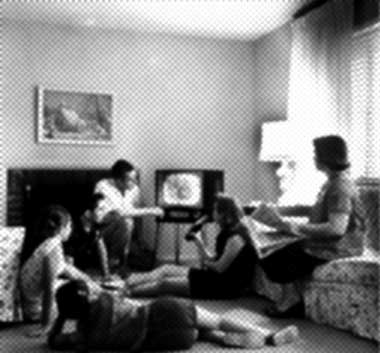
family tv time

TV at the GYM is getting intense

I haven’t been to the gym because I was feeling nasally congested and ill. But today when I went, I noticed some interesting changes to the TV programs and the information presented in the news. Today, at around 12:50PM I saw news reports on some interesting things. There was a mother that was arrested for encouraging her child to fist-fight with a neighbor. On another screen there were advertisements of people playing computer games without actually using a mouse or even touching a screen for that matter, they were using some kind of iPad looking tablet device and were moving the cross-hairs (and invariably the spaceship they were controlling) around by simply holding the pad differently. Then when I was a couple minutes into my stair climb, I saw the other screen show how bunkers have gone up in production in the USA. It seems that people are purchasing large bunkers or else paying for a place in one that is leased by a large group. Some of these bunkers were reported to big enough to hold over 900 people and some were even equipped with detention capabilities. That is so ironic that a bunker that is basically an iron prison under the ground would house another prison within it. The should have another box inside the detention area that is equipped with a combination lock that can keep the thoughts of the prisoner.

These images are slightly different from what I saw a couple weeks ago. There were news flashes of unrest in the Middle East and criminals getting beat down. This is daytime television at the gym mind you. At night it is a little different. What I don’t think people realize is that these images are actually suggestions, it isn’t just unbiased information. This article you are reading right now is saturated with suggestions and subliminal nuance. I can’t help but drench my writing with them, it is automatic.

That being said, the people who sit down and watch Television like this are probably the most susceptible to suggestion. The reason for this, is because anyone who can tolerate multiple commercials of 30 seconds or longer in length in a row is not just a good listen, he or she is part of a captive audience.

So can we learn anything from these trends? I’d say that paranoia has changed from a state of mind, into an actual marketable product that has material substance…kind of like, perfume or flavored water.

Remember, peoples’ purchasing and viewing trends and habits CONTROL the commercials and programming on the media. It is not the other way around, which is contrary to popular belief.

To make this more clear, we can engage in a very simple thought experiment. Imagine that you are a business owner that makes frozen ice-cream lumps that are covered in brownies. (I have never heard of such a product but if anyone wants to go into business making this, let’s do it) Ok, so you have this brownie/ice-cream company called, “Brownie Maxx-Bitz” and you want to advertise on television. Most companies don’t just pick one TV program to sell their products, they have at least two shows that they try and get the product advertised on.

So you have Brownie Maxx-Bitz and you decide that you aren’t sure if this new product would be good to promote on an Soap Opera with a demographic of stay at home mom and dads, or an evening action/suspense program with a demographic targeted at young men in their late teens to early thirties . So you decide to put your ads on both. Over a 30 day period you evaluate the progress of the sales of Brownie Maxx-Bitz and determine that the demographic of young men in their late teens to early thirties is purchasing a great deal of the desert snack.

Well guess what, other advertisers noticed that the had better luck selling their products to consumers on programs other than the soap opera also. And what happened is that the actual value of the advertising time for the action/suspense show went up, while the advertising revenue for the soap opera went down. This led to the producers of the action/suspense show to decide to create a spin off of the show called, “Cyber Cop/Omega Tetralox: Generations of Guilt.” The resulting spin-off show was a great success and now entire college communities refer to Browni Maxx-Bitz as Tetra-Gas Blast due to the high fiber content of the brownie mix used in the early versions of the desert snack.

That was a very simple and crude example of how purchasing trends can affect television but it gets the point across.

So when we look at this in conjunction with TV trends while I’m at the gym, we find that paranoia is a very real thing. And it is actually desired by the media observers.

-Tyler

« Newer PostsOlder Posts »

Powered by WordPress