overidon.com Central Database for Overidon Omnimedia

November 17, 2014

Ethical Theory shows multiple sides of Complex Problems

Filed under: Book Reviews,Reviews — Tyler @ 2:35 pm
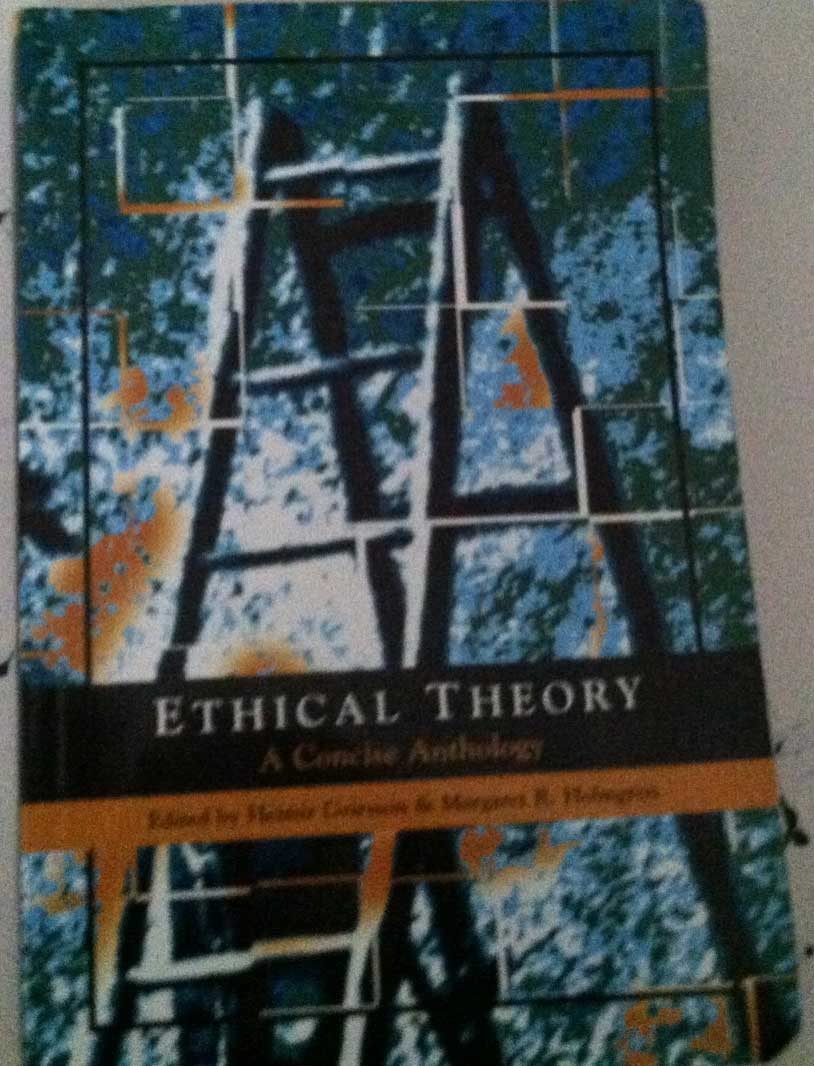
Ethical Theory

Ethical Theory

Ethical Theory a Concise Anthology – [ISBN – 1-55111-292-2] – As you can probably guess, this book is about ethics.

The problem with ethics is that although it has an affinity with logic, it is in no way pure logic. And it is definitely not easy to solve problems using ethics.

What I mean by this is that most logic textbooks tend to use symbols and mathematical constructs in order to prove logical theorems. It is very similar to geometry in the sense that logic uses “proofs” in order to explain the truth or fallacious qualities of a item.

Ethics is different. It in many ways requires layers upon layers of understanding of both sides of a contentious issue. This is troublesome for people like me because I like having problems that are challenging but then certain “keys” or logical pathways can yield quick solutions once they are attained. Unfortunately, ethics does not have these clear cut keys or pathways to their solutions. Ethical problems are at their very core, people problems. And as emotional beings, we tend to carry extra information associated with every issue.

Ethical Theory a Concise Anthology is extremely interesting, instead of being a textbook where one author gives rote explanations and information…it challenges the reader with both modern and ancient viewpoints, opposing counter-articles and intriguing commentary on politically sensitive issues. The bo0k discusses and presents stark viewpoints on issues such as abortion, feminism and the perception of it in modern cultures,  capital punishment and many others.

Not only are issues discussed but also Ethical primary concepts are fleshed out in great detail. These concepts include the more common ones such as the “Good of the Many vs the Good of the One” , utilitarian ideas, the essence of justice, “Do the ends justify the means?” and many other concepts. But what is great is the level of respect and thoroughness by which this anthology delves into each subject. It does not leave the reader with a quick glance and then move on. It truly pelts the reader with so much ideas and such an extreme and almost fractal approach to the intertwining bramble branches of these subjects…that it can easily be re-read for further gleanings.

As an avid reader, this book was tough. I don’t really like over-discussing issues. Unfortunately, over-discussing and extreme explanation of viewpoints is one of the only ways for there to be consensus, relaxation or peace in terms of Ethical disputes. What’s worse, it seems that ethical issues tend to become more complex as new factors arise in a system. So its messy business. What I like about this book is that it gave me a stronger ethical framework in order to understand my own perspectives. So much of what we do as people is controlled by preset dispositions that is hard to analyze without a second mind or outside opinion. It’s as if we need people to challenge and to disagree with us in order to come to more realistic approaches towards problems in a people-filled society.

The more books I’ve ready lately, the closer I’ve come to an important conclusion:

Information in this world is separable into several categories. It is relative, so information must be categorized as to how it relates to the observer of that information. In short, there is the reader (you) and there is the information that the reader is absorbing (the book, the newspaper, the website etc). With that being  said, here is the conclusion.

1. There is information that is directly related to the reader. (Your bank account information, Social Security Number, your favorite colors, likes and dislikes, your thoughts, your dreams, your emotions, the names of your friends etc)

2. There is information that is indirectly related to the reader. (The names of shopping malls that may or may not be within your driving radii, poems and books that could be of interest to you, the technical manual to a device that you may have currently or might purchase in the future based on your “directly related” information.

3. There is information that is neither directly nor indirectly related to the reader. This could be junk to a reader. (Movies that a person does not enjoy, useless books, poorly written articles, poems and books that seem to have nothing to do with the reader)

The conclusion found is that the third category of information…the “junk” data, has tremendous value. This is the information that disgusts the mind. This is the information that helps us to define our opposites, and it opens our pathways to new tastes and intellectual delights.

Of course, Direct and Indirect information is much more important for one’s development and survival than junk. That is an axiom, a self evident truth which is observable. But the junk helps us to identify patterns. If there is a pattern to things that one, “Does not like” then the reader can ask the question, “Why don’t I like this?” By doing this over and over again, it becomes easier to detect at a distance and within a split-second toxic information…and also potential misinformation and/or lies. Now are you beginning to see the benefits of this?

Imagine if detection of lies was an actual skill. Some people in law enforcement and other fields actually get paid on how well they can detect lies!

But this goes far deeper than simple detection of conversational or written falsehoods. What if by absorbing enough information, and then processing that information, a person could detect deep fissures in logic and rifts in reasoning?

This is the very reason why I decided to push myself to read Ethical Theory a Concise Anthology cover to cover. It wasn’t that I was actually interested in this subject matter. As an avid reader, I knew that this information would help chisel away at my own contradictions and potentially pave inroads to greater opportunities.

I argue that there should be a primer for the information we ingest.

For a rough rule of thumb, I’d say we should consume about:

A: 20% information every day that is related to the reader (Direct Information)

B: 50% information that is indirectly related to the reader (Indirect Information)

C: 30% information that is neither indirectly or indirectly related the reader (Junk Information)

The thinking for this is that the Junk will help sharpen the mind of the reader. The patterns in the refuse, will help the observer to learn to refuse what is unnecessary in the moment.

If 30% Junk is unpalatable…simply pull it back to 10 or 5 percent. It doesn’t matter…it’s your life. But the more we push ourselves to digest more, the more alive and complete we will become.

Like my mom always said, “Try something new every day!” and that especially pertained to food, but I’m widening the scope slightly.

-Tyler
November 4, 2014

Sonic Attacks in Modern American Cinema

Filed under: Observations — Tyler @ 9:00 pm
tinnitus

tinnitus

Have you ever heard of tinnitus? It’s a strange “ringing” sensation in one’s ears. People usually get it after getting a knock on the head, overloaded by noise, or during an extreme headache such as a migraine.

Please note, the rest of this article may be disturbing to some readers.

It’s easy to tell if someone is experiencing tinnitus. All one has to do is simply turn the lights down low or off, and be in a quiet room. If one has tinnitus, a ringing sound will seem to come out of no-where. It can almost seem to come from within someone’s  own head.

Now, if one listens closely to this sound. It tends to have a definite tone, a type of frequency or “white noise” almost musical characteristic. It is very unpleasant. Yet we have heard this sound before…

If any American walks into a modern movie theater that is showing traditional First Run blockbusters and big studio productions, he or she will notice a type of fatigue after the film. This is more than just the flashing lights and loud booming sounds. Pay close attention to the films you watch…especially the ones that seem to fatigue the viewer at the end of the film. Over 80% of the films sampled in the last 2 years have had actual sonic attacks inside the films.

These Sonic Attacks are almost identical to tinnitus. The occurrences of these attacks are so common even across genres that it is almost obvious. But let’s spell it out in more detail.

The Best of Me – Romantic Drama – 2014 – Sonic attack after the main male character is blown from his Oil Rig

If I Stay – Young Adult / Drama – 2014 – Sonic attack during the scene where the main character is waking up after a car crash…only to realize that she is extremely hurt.

The Giver – Drama – 2014 – This film in particular is of special interest. The sonic attacks are much more subtle than the standard tinnitus sound in the above mentioned films…yet the attacks are far more frequent. Almost every scene where Jeff Bridges’ character delivers a “memory” includes a type of sonic attack. But what is specifically intriguing is how the city’s primary leader, played by Glen Close, gives the main character instructions that he is not allowed to take any medications for pain.

Man of Steel –  Sci-Fi /Action – 2013 – Several Sonic attacks, especially during Superman’s childhood, strangely enough after the “Oil Rig” explosion scene, (noticing a pattern here yet?) and several occurrences of sonic attacks during “helmet” scenes concerning the enemy characters being “overloaded” by sensory information

Divergent – Young Adult / Action – 2013 – When the main character is boxing, she gets badly injured and there is a short sonic attack. To the viewer it seems minor and is almost expected since she got hit. (NOTE: why are sounds which are often attributed to severe headaches being used in Mass Media entertainment?)

Avengers – Sci-Fi /Action – 2012 – During the scene where Iron Man, falls from the sky and is disoriented and almost comatose (or dead), a sonic attack occurs. This is only broken by a secondary sonic attack of screaming by the Hulk.

The Hulk – Sci-Fi/ Action – 2009 – This film is so riddled with sonic attacks it is almost beyond mentioning. The scene that should be paid extra attention to is the “University Skirmish” with the soldiers vs. the Hulk. In this scene trucks with large SPEAKERS pointed at the Hulk are used to attack the Hulk. If there is another film which more blatantly uses sound weaponization than please leave a comment below. We’d like to know.

Concluding thoughts:

1. Perhaps filmmakers are noticing better box-office profits for films that have sonic attacks as part of their audio tracks. This could be a product of American audiences’ propensity for self-punishment. Being sonically punished in groups could be a sort of bonding experience for young adults and adults.

2. Everything included in a film costs money. So nothing is done on accident.

3. This could be part of a bigger picture. People who are most resistant to sonic attacks tend to be people who are the least susceptible to headaches. This group can be further split into two categories: A. People who can’t hear very well and especially have trouble hearing nuances and subtle sounds in music and films. B. People who can hear normally, but whom have adapted to sonic attacks in modern life. Could these sonic attacks in Modern American Cinema be part of a bigger initiative for the conditioning of the American Populace? If this is so, what will the end result of this conditioning be?

-Tyler

October 18, 2014

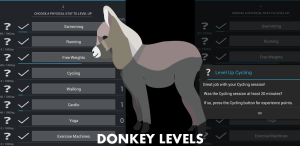
Donkey Levels is now available and on the Google Play Store

Filed under: Overidon News — Tyler @ 10:09 pm
Donkey Levels - Click the image to download the app from the Android Play Store

Donkey Levels – Click the image to download the app from the Android Play Store

Donkey Levels is an app made by Stimtrano Productions. My name is Tyler Jaggers and I’m part of Stimtrano Productions.

As the Lead Programmer and Developer of Donkey Levels I can easily say it has been a complete pleasure working with Jeffrey Chao our Executive Producer.

Jeffrey has manifested his vision of creating an app where YOU are the main character in leveling up Physical and Mental stats.

One day at a Pho’ restaurant a few months ago, Jeffrey came to me with the idea of Donkey Levels. We had some basic concepts of a progress bar for hiking and swimming, but there was more to the picture.

Donkey Levels was going to be an app that motivated people to do what they have always have ever wanted to do.

In games, the main character is often given the opportunity to track his or her progress or “level” with strength or dexterity. Also, the character can become stronger by working on basic skills. Leveling Up is a common theme in most modern Role Playing Games and it makes great fun.

In Donkey Levels, we have progress bars for:

Physical Stats

swimming
running
free weights
cycling
walking
cardio
yoga
exercise machines
sports
active work

Brain Power Stats

meditation
memorization
puzzles
stimulating games
mental math
reading
critical thinking
organized planning
design
relaxation


The user can track his or her development in any of these areas by simply pressing a button. Each button press correlates to Experience Points (xp) that helps the Donkey Leveler to have a visual representation of his or her real-world goals.

I can’t tell you how excited I am about releasing this app. Not only is it currently a Free App, but the developmental process itself has made me personally grow as a programmer and human being.

Download Donkey Levels today for Free from the Android Play Store by searching, “Donkey Levels” or use this url:

https://play.google.com/store/apps/details?id=com.stimtrano.donkeylevels


-Tyler

October 9, 2014

James Loewen brings more researched Footnotes than a Dance Instructor

Filed under: Book Reviews — Tyler @ 11:35 pm
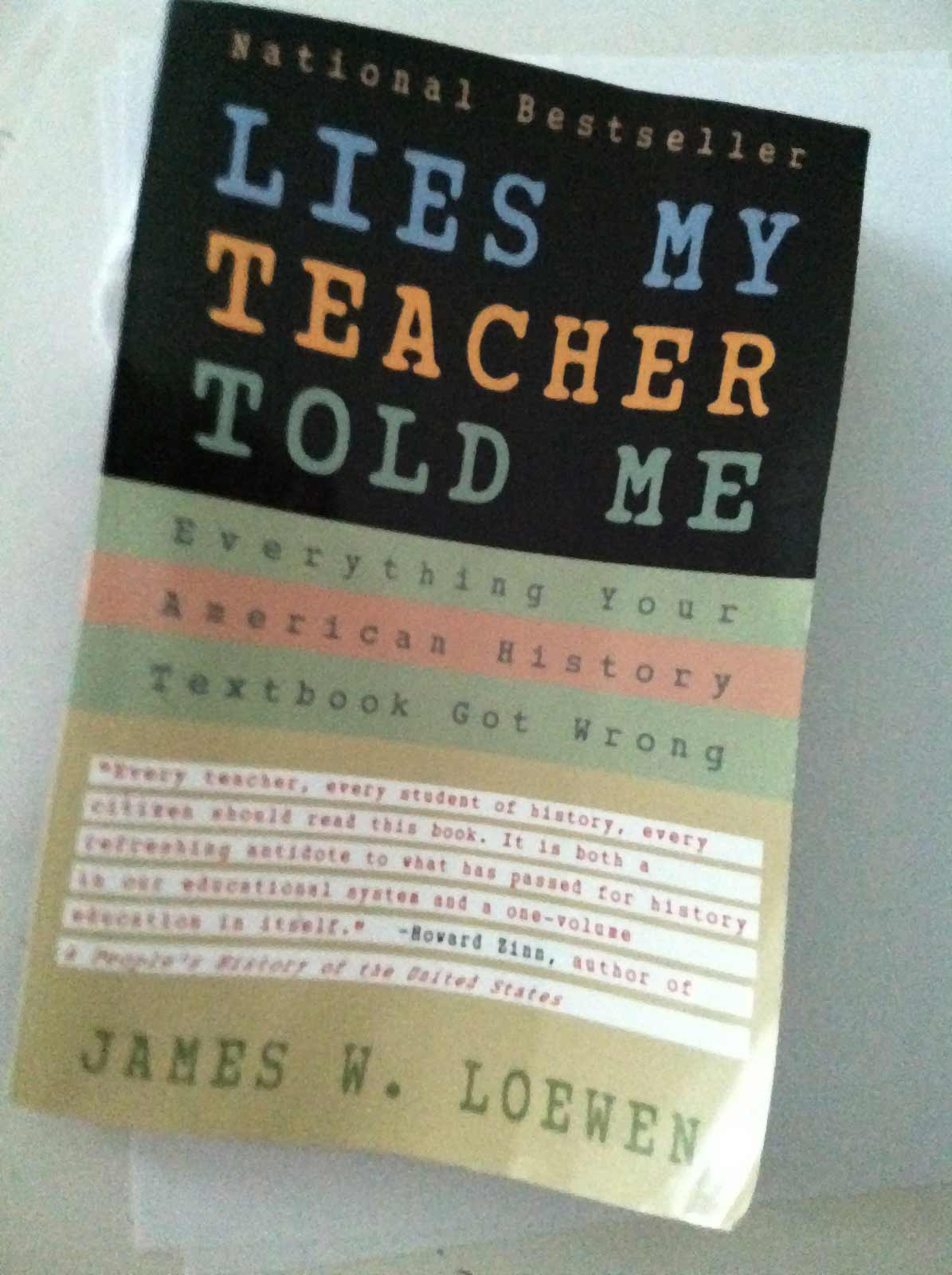
Lies my Teacher Told Me

Lies my Teacher Told Me

Lies My Teacher Told Me is a Touchstone Book published by Simon and Schuster. It has an ISBN of: 0-684-81886-8 and if you enjoy reading the back stories that aren’t exactly popular or perhaps are a bit disturbing…then read on. This book goes way beyond normal American History. It talks about the inaccuracies, exaggerations and sometimes complete falsehoods that are taught in High-School History Courses. Do not read this book if you don’t want your mental concepts challenged. Because Lies My Teacher Told Me does not pull any punches regarding all the Historical Taboos that you can imagine.

First of all, did you know that most of the history we learn from textbooks in High School…isn’t even prepared by Historians? This confused me. In the book, you find out that the people listed as the primary authors on the spine of a High School history book aren’t even remotely part of the authoring process. These names could be from several revisions ago.

Life is so complicated. We often tend to try and find external reasons for why things are the way they are. In this book, James W. Loewen discusses that history doesn’t show how individuals are able to influence tremendous change. Many times, we hear growing up certain names, but they almost seem anecdotal. Individuals aren’t the primary reason why we have certain freedoms…or so we think.

After reading this excellent book, I’ve come to realize that we’re right…actually. History isn’t forged by individuals. And it isn’t made better by groups either.

The things we cherish most about the world and how our civilization function, has been made possible by a string of individuals. It’s like thin strands or chains of people staying true to themselves over time. The length of the chain is the connection these individuals have throughout history. Sometimes several chains of individuals strand together to make intricate weaves and latticeworks of political and conceptual structure. But the root elements are people…people who want to make a difference.

With so many well-researched notes at the end of the book, I couldn’t have felt more satisfied. This is one of the many books I’ve read lately that had not only detailed notes with excellent bibliographic information, but the notes also often include excellent explanations of why the note exists. This was extremely satisfying, it was as pleasing as those extra scenes that happen at the end of modern big-budget action films. I want to know what happens next.

Loewen goes beyond simply talking about misinformation in American History. He discusses the entire process of education and how History for some reason doesn’t get the same type of attention as Math or Science. There rarely are special interest groups that protest or boycott a Math textbook. Yet after reading Lies My Teacher Told Me, I’ve learned about the many levels of decision-making that goes into the publishing of a History Textbook. Did you know that the profits made from History Textbooks is a trade secret? Education is a big business.

I don’t want to give spoilers on this book. Just read it for yourself. You’ll probably know a good chunk of the information in the book already. But I didn’t know more than 70% of the stuff in the book. So that’s pretty good.

-Tyler

« Newer PostsOlder Posts »

Powered by WordPress