overidon.com Central Database for Overidon Omnimedia

October 12, 2012

Funnel Clouds spotted in Huntington Beach Area

Filed under: Ecosystem — Tyler @ 9:27 pm

Huntington Beach - Funnel Clouds

Huntington Beach – Funnel Clouds spotted 10/12/2012 – [PHOTO CREDIT: A. MALOUF]

What do unpredictable funnel clouds, mushroom burial suits, and forests in the middle of former unused farms have in common? …find out in the provocative and unsettling article below. But be forewarned, the concepts and suggestions in the article could be disturbing for some readers.

Today, 10/12/2012…two funnel clouds were spotted in Huntington Beach, California. The observer, A. Malouf has given us the pleasure of using the photo to the left as proof of the eye-witness account. You can click the image for an expanded view.

Although the funnel clouds were not reported to be tornadoes, they are nevertheless strange weather for the coastal community.

Regardless of whether or not global warming and/or man-made climate change is attributable the odd weather Southern California is experiencing, one thing is for certain: Autumn has come late, and now that it’s here, it doesn’t seem like any El Nino that we can remember. Hail Storms in Pasadena, Funnel Clouds in Huntington Beach and other freak weather have changed the minds of residents to expect the unexpected. Low morning clouds and slightly hazy sunshine just isn’t the norm anymore for our daily forecasts.

We are experiencing record heat waves, followed by drought and then intense, yet sporadic storms.

It may seem like the best way to deal with strange weather is to prepare for it by having emergency equipment, water back-ups, rations and redundant communication in case of a serious environmental catastrophe. And although these preparations are both excellent and practical…preparation alone is not the optimal way to handle freak weather.

Deserts, out of all the different types of ecosystems, seem to experience the greatest of extremes in weather. They get the hottest during the day, and at night they can get extremely cold. Since Southern California is primarily a desert, we have overcome much of the hardships of our climate by using aqueducts and irrigation for water distribution and air conditioning for indoor temperature control. But is there a better way to cope with challenging climates?

In a previous article, we discussed the potential for reforestation in the United States. Forests, rainforests and large jungles above all other ecosystems have the most predictable and survivable of climates. Even jungles which experience monsoon weather often experience this during timely and predictable periods, and the monsoons are key to the survival of the jungle itself.

Russia has dense, old-growth forest zones. These old-growth forests have typically warmer and more hospitable weather conditions than their tundra counterparts.

The reason why forests tend to have better weather and climates than deserts is because of one primary factor: Forest zones which are teeming with life actually adjust the weather in order to create a climate which is more amicable to the homeostasis needs of the life-forms within that very forest zone.

What’s the connection?

Well, contrary to popular belief, forests are actually simple if not the simplest of ecosystems to create. If one wishes to create a forest, the required parts are: surface area, rocks, water, dead organic material, plant material, fungal systems and of course…time.

New breakthroughs in the understanding of fungal systems and a more mature approach to how mushrooms are depicted in the media making rapid forest production more plausible.

In the video below, you will see a presentation by Jae Rhim Lee on the concept of mushroom burial suits. These suits are intended to help break-down the toxic chemicals within dead human bodies so that those very chemicals do not pollute the soil.

Although the video is both enlightening and interesting, Jae Rhim Lee is missing a monumental opportunity which dead mammal bodies represent. This opportunity is that dead humans and other mammals are rich with nutrients which could be directly used in the seeding of artificially created forest zones in the USA.

It doesn’t take a Necromancer to know that dead mammals do a lot of strange things after a few days. If you’ve taken a biology class recently, you’d know that human bodies are traditionally buried or burned after dead because the bacteria within the stomachs of corpses create gasses. These gasses build up until the dead body explodes, sending necrotic material forth in all directions.

The practice of burning and/or burying humans after death is excellent for creating a plague-free society, but the tradition wastes a renewable resource which could directly fuel the expansion of experimental Reforestation Zones within unused farms in the USA.

The major benefits of controlled, experimental forest zones include:

1. Climate Control and Stability – The more dense forests that exist in the USA, the more stable weather systems will become. Also, experimental forest zones will be able to exceed the density limits of naturally occurring forests. This is due to new research in fungal systems, botany, geology and biodiversity. Therefore, these experimental zones should be placed in or near the center of the United States in order to maximize radial expansion.

2. Pharmacological Research – Rainforests and other dense forest environments are the primary sources for research into life-saving drugs. By creating artificial forests, scientists will be able to eventually modify the parameters of specific segments the environment in order to maximize the germination of specific species of plants, fungi and other living creatures.

Of course there are definitely religious and societal implications to using human corpses to seed forests within our nation’s borders. Similarly to how a person can opt-in to having the “DONOR” sticker on one’s Driver’s License, one should also have the option of having their bodies donated to this project at the time of death. If one has a DONOR sticker and also a “REFORESTATION” sticker on one’s license, the authorities could extract any useful organs first and then donate the rest to the reforestation project.

Also, since other smaller mammals like cats and dogs are full of nutrients, euthanized pound/kennel creatures should be considered a source of corpses for this project. I know how strange this must sound, but put quite simply, cremation of cats and dogs is a complete waste of resources. Although this subject matter is morbid, once the uncomfortableness of facing mortality is overcome, significant societal opportunities can be appreciated.

Consensual subsystems are the key to the success of any major environmental project.

Before jumping straight into the construction of experimental reforestation zones, a few precautions need to put in place.

First and foremost, three perimeters need to be established around each zone. The innermost perimeter needs to be the containment perimeter. This circular or semi-circular perimeter will make sure no plants or animals exit the zone. Any plant life should be burned and any birds or animals seen exiting the inner perimeter need to be killed and their bodies redeposited into the zone. The reason for this is because animals which exist within the zone will have eaten human beings and therefore are contaminated.

Also, no humans which are not in protective bio-hazard gear should be allowed into the innermost zone. Preferably, drone trucks with simple, shallow grave burial tools should be the only outside units allowed into the primary zone. Although some human scientists will be required for occasional special projects and high-value resource extraction.

The secondary perimeter should be used as a buffer zone and for coordination purposes. Relay stations and towers should determine the proper comings and goings of the reforestation zone. Logistical support for trucks and information extracted from surveillance and sensing technology withing the primary zone will be data-mined, organized and disseminated from the relay stations within the secondary zone. Since forests require large rocks and irrigation to get them past the fetal stages of their development, the secondary perimeter and its logistical relay stations will be key to the success of each experiment.

Finally, the tertiary perimeter will be a large zone which makes sure the scent of the deteriorating material and organic decay does not transfer to populated regions. One can already predict how, Not In My BackYard (NIMBY’s) communities would rally to prevent such experimental reforestation zones from expanding near their homes. This situation could be avoided by securing enough acreage to diffuse the smell of the experimental reforestation zones.

All this work and planning may seem daunting at first, but a coordinated effort for changing our climate and investing in our biodiversity future will yield opportunities which far exceed any initial cost. In fact, the secondary zone discussed earlier could be rented out to communities of hunters as a sort of “Specialty Rare Game Hunting.” Some hunters are willing to pay enormous sums of money to legally hunt rare animals. And since the animals that exit the primary zone will need to be killed in order to maintain biohazard security, after a few years, hunters could be given rental licenses for hunting rare game which none could find anywhere else.

The concepts are suggestions discussed in this article are part of a method of thinking called, “Cybernetic Societies.” Although many of us think of the Terminator when the word, “Cybernetic” is used, the actual meaning of the term relates to using oftentimes complex and interconnected artificial and/or natural systems to achieve a desired result. We should not fear melding the technology of the information age with the recent advancements of biological research.

In order for humanity to exist comfortably within our changing environments, we should use the largest known lifeforms -forests- as human shields against harsh climatic changes and freak weather phenomenon.

-Tyler
October 11, 2012

How a man got a Wild Hummingbird to Land on his Finger

Filed under: overidonTV — Tyler @ 6:31 am
hummingbird on finger

Click the picture to watch a video showing “Broken Beak” land on my Dad’s finger!

We’ve all seen popular films like “Ladyhawk” where outstanding characters outstretch an arm and a falcon perches with the greatest of ease. But have you ever heard of someone training a wild bird to land on his finger? In the video below, you’ll see how my Dad actually gets a wild hummingbird named, “Broken Beak” to rest on his finger while enjoying an afternoon drink.

Here’s how Ken got Broken Beat comfortable enough to land on his finger:

Everyone loves traditional hummingbird feeders. The birds get the enjoyment of having a free, easily accessible snack. And the viewers get to see these wonderful creatures buzz around with their remarkable speed and hovering ability.

Although hummingbirds do not require a perch to drink from a feeder, some prefer to land on a twig or perch while slurping up nectar with their flapping long tongues.

My Dad has been feeding hummingbirds for years and a few years ago he started to notice the birds became less and less scared of people and our Yellow Labrador dog. After noticing the hummingbirds would buzz literally right by his head when trying to get to the feeder, he got the idea of holding out a thin twig for birds to use as a perch.

Over the years, the hummingbirds got used to the twig perch, they even would rest on the twig while Ken would hold it for several seconds. You can probably guess how a bird enthusiast would enjoy having a completely wild neighborhood bird rest that close to an observer.

Recently, a hummingbird named, “Broken Beak” has become so accustomed to using a twig as a perch, that my Dad decided to experiment with holding out his finger.

To my amazement, the last time I visited my parents, I was able to capture Broken Beak drinking from the feeder for almost a minute while resting on my Dad’s index finger.

Check out the video below to watch Broken Beak take a drink!

-Tyler

September 28, 2012

Overidon Wind Acceleration Generator

Filed under: Innovation — Tyler @ 3:23 am
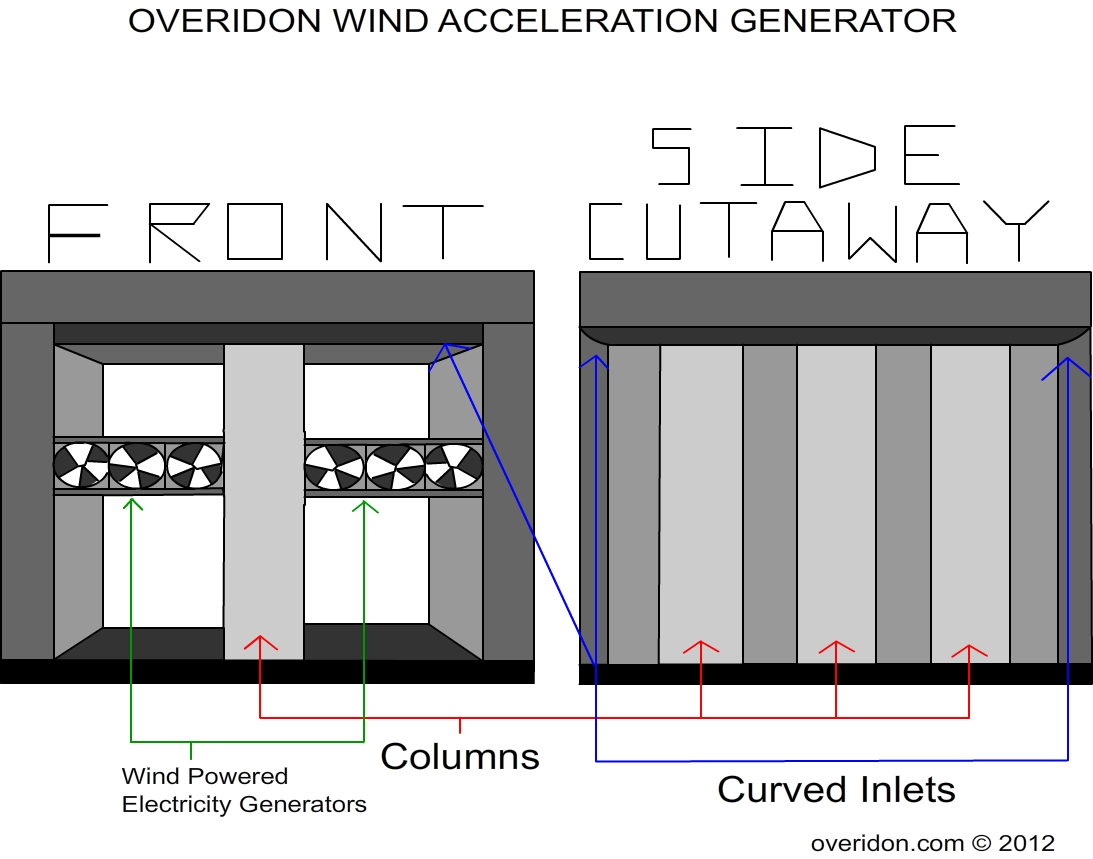
Overidon Wind Acceleration Generator

This device uses an inverse of the Bernoulli’s Principle in order to create high-speed air currents which can be harnessed by Wind Electricity Generators

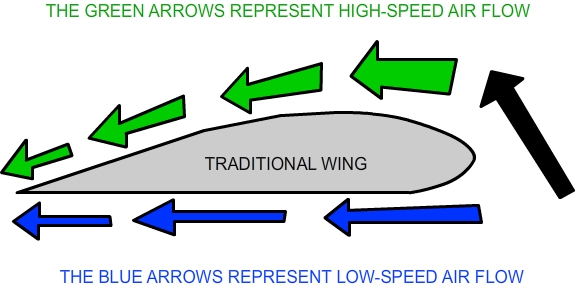
Bernoulli is a well-known scientist who pioneered advancements in the field of thermodynamics among many others. One important piece of knowledge he imparted to us was his insight into the concept of ‘lift’ and how wings can make objects overcome their gravity in an open system.

In the image at the bottom of this technology concept, you will see a rough diagram which shows how air flows over the top of a wing and how it increases in speed. When that happens, the pressure on the top of the wing decreases and the pressure below the wing stays the same. This creates the ‘lift’ which was discussed earlier.

Imagine inverting the system and putting the wing upside-down. The ‘lift’ would happen on the wrong side of the wing, and the object would travel downwards in the open system.

It was this hypothesis/concept which led Overidon Industries back in 2008 to experiment on a small scale in Santa Ana, California with models somehow utilizing this idea. Except instead of using a wing, the inverse Bernoulli concept was put on a fixed structure.

The idea was as such: If the inverse wing was attached to a fixed structure, the air-flow inside the structure would increase in speed. Since velocity takes priority over pressure when it comes to harnessing energy from wind turbines, a permanent structure or system which increases the velocity of air-flow would be a way to amplify the power of wind generator systems.

In 2008, the models were too miniscule in size to show any real change in air flow.

Yesterday, while walking home from the park, it was observed that the air flow underneath a freeway overpass in Pasadena was moving significantly more quickly than the perceived flow of air outside the area of the overpass.

At first glance, this seemed like the wind had changed speed in a short amount of time. But what was really going on, was that the overpass structure itself was affecting the air flow in the area.

This was confirmed by walking back beneath the overpass a second time. It was as if an artificial gust of wind was created out of thin air.

The angular inlets underneath the overpass acted as inefficient yet effective inverse Bernoulli wings which decreased the pressure underneath the overpass and invariably increased the airspeed.

One might be tempted to say that the overpass created a net-zero effect by changing the air-speed and that kinetic energy which can be extracted from the system is actually the same as it would be if no inverse-Bernoulli effect was observed. This would be quite true if the air-flow existed in a closed system. Yet since the system is open to the rest of the surrounding air currents, there is actually no limit to the amount of air which can be harnessed and directed.

To better illustrate this point, an analogy would be appropriate. Think of a biological enzyme within the human bloodstream. These devices are infinitesimally small pieces of technology which perform specific functions upon chemicals and organic compounds within the bloodstream and inside certain cells. These enzymes are more similar to machines than they are to animals. And they function upon their targets not by any means of stored chemical energy or through genetic processes…enzymes do their work through their unique shapes and structures.

It is the shape and configuration of an enzyme which determines how it will affect another entity in the bloodstream.

Air Flow

The structure of the wing creates fast air-flow over the “hump”

The large concrete devices that are proposed by this concept are similar to enzymes. But instead of using their structure to affect organic compounds, this technology uses the Bernoulli Principle to interfere with the air flow. This three-dimensional interference pattern is what creates the “noise” which increases the speed of air flow underneath the overpass.

The reason why the term, “noise” is used is because two-dimensional sound is what is created by guitar strings or violins. This sound is potentially harmonic by nature of the vibration. Drums on the other hand, create three-dimensional sound and this type of sound is called, “noise.” Noise cannot harmonize with noise, neither can noise harmonize with two-dimensional sound. Noise patterns have unique character which can only be amplified, enhanced and modified.

By creating a sort of “noise” in the system, the overpass successfully changes the vibrational character of the air-flow. And since there is no limit and more importantly no cost to the amount of air which can flow through the system, directly modifying the air pressure and wind velocity via the structure has enough value to overcome any lack of perceived kinetic energy in the air system.

This takes us to the concept itself and adaptation.

By changing the angular inlets of the freeway overpass to curved shapes, the structure will more-efficiently create the inverse Bernoulli effect upon the airflow. When this change takes place in conjunction with the addition of wind generators placed strategically in the center of the areas of rapid air-flow, the device will be known as an Overidon Wind Acceleration Generator (OWAG).

This generator can be augmented by painting certain sections of the roof of the device black in order to absorb additional heat.

Further augmentations could be attained by combining OWAG units together in concert in order to amplify the desired effect. In reality, it would greatly benefit the OWAG systems if additional “Turbo Charger” systems were built to further recycle rapid-moving exhaust out of the tail of the OWAG.

In the end, an arid tundra or bleached desert in the middle of the United States with only modest air-flow patterns could be transformed into profitable systems for creating lucrative electricity for both domestic use and export. Used strategically in conjunction with coal, natural gas, traditional wind generators, and other energy production techniques…the United States of America could have OWAG units as emergency backup generators in case of an emergency or as “cooling” devices to keep a lid on potentially volatile future energy prices.

Perhaps advancement in architecture, cement mixing and civil engineering could be used together to leave a lasting legacy for our progeny to use during their future generations. As the people of tomorrow comb the surface of our land for glimpses into the minds of their ancestors, they will see structures set in stone…organs, in the sand.

Overidon Wind Acceleration Generator (OWAG)

© 2012 Overidon.com

Tyler Stansfield Jaggers – September 28th, 2012

September 24, 2012

Alien vs Predator the Next Gen PC Game is a Must Play

Filed under: Gaming — Tyler @ 3:36 pm

As a serious fan of the Alien film franchise and also the Predator film franchise, I was extremely excited to play the most recent instance of Alien vs Predator for the PC. It is actually part of a long series of AvP games. The first one that I can remember came out for the arcane system known as “Jaguar.” This system was supposed to be cool but it was short-lived.

In 2000, I tried playing the game, Alien vs Predator for the PC, but I had some sort of sound issue. There was a popping sound consistently when attempting the human missions and thinking back on it, I may have mistaken the radar blip motion detector sound as some sort of game glitch. I spent hours in my dorm room trying to figure out the sound problem and I was pretty gruff towards my neighboring dorm-mates. After giving up on getting that game to work (which actually was working perfectly) I forgot about Alien vs Predator.

Years later, I was living in Costa Mesa, and I wanted to check out Alien vs Predator 2. This game was phenomenal. It had something that I never expected…an experience of the “Complete Alien Lifecycle.” This means you got to be a facehugger and find an appropriate victim, then you popped out as one of those chest-burster aliens until you had to find a suitable snack. And finally you got to morph into an alien drone and then go about on your adventure. Not only was the Alien aspect of the game great, but the Predator as well as Marine missions had great combat and subtle story-lines. Similar to the game, “Unreal” you would find notes and computer journals which gave additional context to the story. It made the entire game have dense atmosphere and rich ambiance.

Last year, I played the game, “Alien vs Predator” which is actually just the most recent next-gen version of the gaming franchise. Although the game lacked the full life-cycle aspect of the alien missions, it was extremely fun to play. The human missions were simply awesome with the addition of the new sniper rifle system. The marines have this rifle which not only has sniper zoom but it can see through some cover and walls…and it can also highlight enemy targets which may be cloaked. Also, there are androids in the game which are very powerful and cool, if you think you can beat them with a simple headshot…think again.

The alien missions are interesting because the Alien Queen has a psychic link with you and her drones. You get mission objectives from her and it makes the game feel like you’re part of a larger unit. In the last game I was talking about, you feel more like a mystery drone which is going about things like a rogue. But in this game you have a history with the human scientists and there is a little revenge/larger mission scope to experience.

As for the Predator missions…simply wow. The architecture and amazing artwork makes these missions feel like you’re going on some sort of expedition in Peru but there’s more danger of course. They added to this game an intuitive super-jump system which is activated by using your secondary visor/sight ability. It gives the game a more rail-type experience at first, but later in the game you will see that the leap system is not meant to limit your movement but rather to assist in showing you which leaps are possible so that you don’t waste time with a jumping test every-time there’s a ledge which you are curious about. I think this actually adds to the realism of the game because you rarely see in the movies a Predator miss a jump and then fall on his hind-quarters. He always seems to know if he can make a jump.

To make the Predator missions even more exciting and intriguing, there are holographic representations of Ancient Predator historical events within the temple. It is as if you get to witness an important event within their culture with front row seats.

Overall AvP is a great game for the PC and it is an innovative FPS with fast-paced action!

-Tyler

« Newer PostsOlder Posts »

Powered by WordPress