By using a basic Equilateral Triangle guide – I can already tell that my construction will be off balance by at least 20% which is unacceptable.
Sacred Geometry is an interesting concept. It is riddled with emotional responses and spiritual imagery.
For good reason, this form of art is evident in both mathematics and natural biological forms. Yet despite its abundance, sacred geometry has the ability to mesmerize and inspire the viewer.
The function of sacred geometry is different for whomever is viewing and distributing the art. Some may view sacred geometry as a way to focus, others may meditate upon the shapes. Even more interestingly, some people can use sacred geometry to sharpen the mind and they even reproduce the art in order to push the limits of their preconceptions. Yet other people use sacred geometry as a way to relax and ‘chill out’ and let the world melt away against a backdrop of impossible perfections.
On the flip-side, sacred geometry has a few specific functions for those who disseminate the art.
The most primary function of sacred geometry seems reflexive, but it is quite important.
The primary function of sacred geometry is for those who see it…to remember the sacred geometry.
Does that seem strange?
Why would a type of art have the primary function of having someone remember the art?
This may seem like a strange form of advertising…and interestingly enough sacred geometry is used quite often in branding and modern advertising. Yet it should be noted that sacred geometry is actually…useful.
That’s right, from crosses on churches to pyramids and equilateral triangles…sacred geometry can help you get your work done. And this article will explain how it helped me with a very specific problem.
As one learns more about sacred geometry, there are a few types of art which appear over and over again. The first is the cube or more specifically the “Metatron’s Cube” this cube. The Metatron’s Cube is the reason why you made so many cubes in junior high school. Cubes are 3D, cubes are fun. They’re both easy to make and you can put stuff in them. The absolute best part about the cube is that it appears all over the place. Almost any kind of complex connection and collection of points will resemble a cube if you connect enough dots. If one understands the true taste or nature of the cube, he or she can easily tell when a cube is nearing perfection…or if a cube is poorly constructed.
This ability to sense perfection from distorted shapes relates to the primary function of sacred geometry. If a piece of geometry art has too many imperfections of angles, lines or curves it is considered art or just a rendering of something. The term sacred geometry is reserved for images of geometric complexity, either implied or clearly illustrated that are perfect to the naked eye. When the human eye and mind perceive well-constructed sacred geometry we tend to snap our attention either directly, or else gaze and relax into the complexity. Both extremes push the limits of one’s mind either aggressively or in a relaxed manner. The effect of sacred geometry is completely controlled by the viewer. No two people react to the art in the same way.
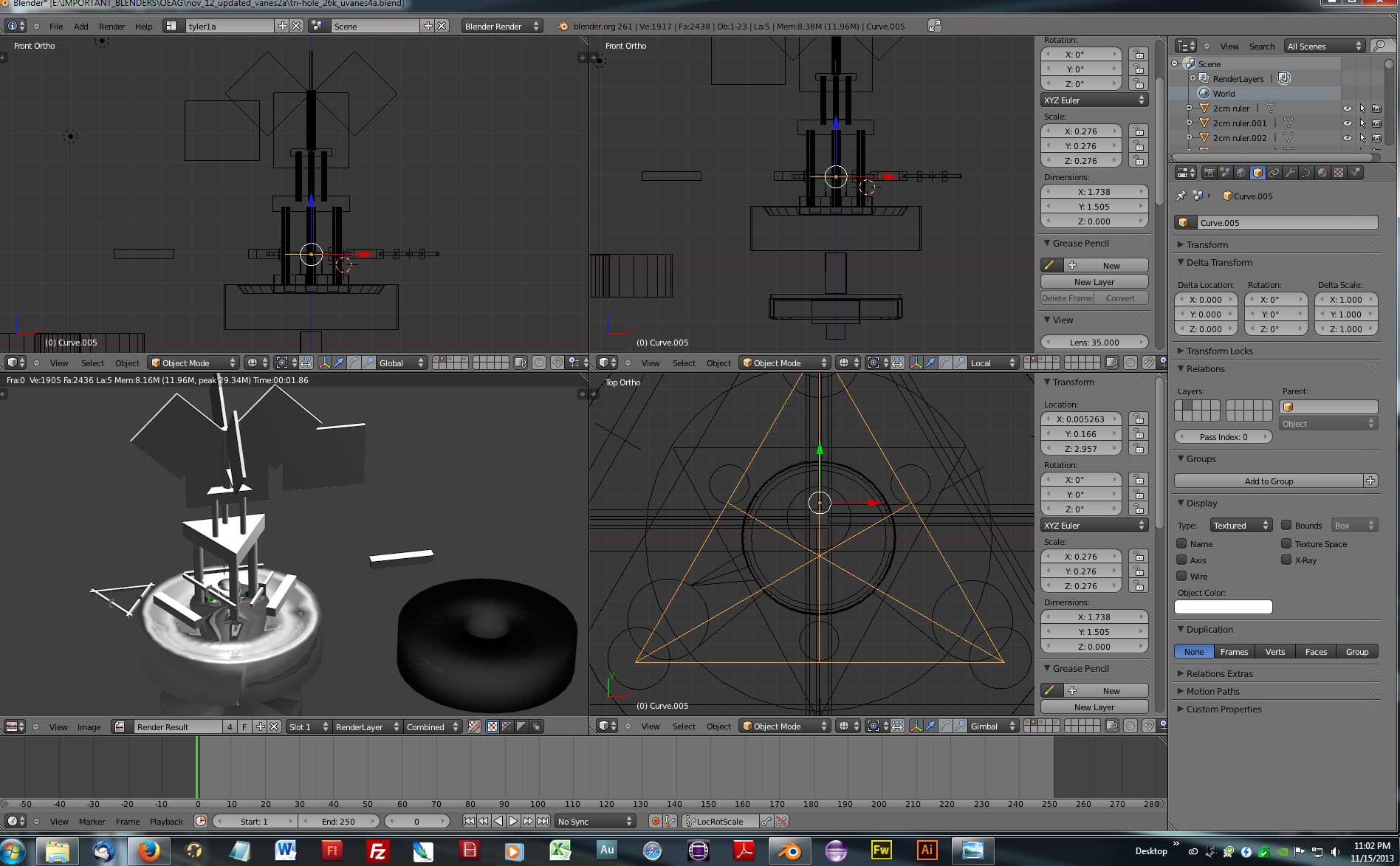
Another form of sacred geometry is the slicing and dicing of basic geometric shapes. For example a bisected equilateral triangle, may seem very basic and boring. But it in fact can be extremely useful. Unlike a square, the equilateral triangle is a durable and strong shape. Also, the equilateral triangle when used in constructions can be reinforced and scaled with ease. That’s why in the image above you see the bisected equilateral triangle on the bottom right.
In the project that I’m working on, my goal is to have a cylinder placed in the center of an extruded equilateral triangular base. This may sound like a mouth-full but all I’m saying is that I need to have a circle smack in the middle of a triangle.
Within the program called blender which I use for 3D art, there is a technique for aligning the center of an object to its geometry. That command function is ” Ctr-Alt-Shift-C “ but there’s a problem. Although this command aligns the center to its geometry, the center may not be exactly right. The computer doesn’t know exactly how to handle every single shape…this is compounded when an object is in 3D space with many other sub-objects.
In my scenario, the program Blender was aligning the center of my object too close to one of the vertices of the triangle. And as you can see, the center of the object does not match up with the center of the orange bisected equilateral triangle.
This actually correlates to value to me. Since I sent this object out to be constructed by a 3D printer, I did a draft first in plastic before requesting a steel model. I wanted to make sure I didn’t waste money on a lop-sided steel frame. And even though I haven’t received my object in the mail yet…I know by double checking my work, that my object will be off balance. Even though the object will most likely spin under some pressure, it won’t be nearly efficient enough to handle a rigorous experiment.
By looking at sacred geometry often, I was able too get a “feeling” that my object just “wasn’t right” even though the object looked quite stable. That’s one of the benefits of sacred geometry, the exposure to perfection can trigger a mental galvanic or discomfort in the mind whenever imperfections are visible. Although it would have been beneficial to have caught this problem before I sent out the object, the learning experience was valuable enough to make me shrug at the $20 which has gone down the drain. Besides, any experience which encourages fact-checking can have value if it is regarded with respect.
My only wish is that those who read this article can save themselves some time and/or energy by utilizing sacred geometry in whatever can be of use.
On a funny side-note I remember learning early on as a child that drawing circles around perfect geometric shapes was related to arcane teachings. Nothing can be further from the truth.
Drawing a circle around a geometric shape is an easy way to tell if your shape is aligned and/or configured properly. That’s why it is so common to see mechanical objects like wheels, rims and pizza cutters to have circles within circles which are connected by plus or cross-shaped objects. It’s not magic…it’s technology! Use it and have fun! Sorry to say but your pizza party is not a summoning circle for “Gorgomashlammatrax.”
After I receive my object in the mail, I will make sure to compare my notes with the bisected equilateral triangle. Then I’ll be able to have a better center of gravity for my 3D art project.
I hope you enjoyed the article!
-Tyler